
Two pairs of painted eyes watch over Kathmandu. Swayambhunath gazes from its forested hilltop in the west; Boudhanath from its great white dome in the east. They are the city's two most important Buddhist monuments, both UNESCO-listed, both alive with daily devotion, and they could hardly feel more different. The differences come first, then each stupa in turn and a plan for seeing both in one day.
Boudhanath vs Swayambhunath at a glance
| Swayambhunath | Boudhanath | |
|---|---|---|
| Setting | Forested hilltop, west Kathmandu | Flat ground in a Tibetan neighbourhood, east Kathmandu |
| Getting up close | 365 steps (or a road to the west entrance) | A level walk into the square |
| The draw | City panorama, shrines packed together, monkeys | The kora, monasteries, rooftop cafes |
| Community | Newar Buddhist and Hindu shrines side by side | Tibetan Buddhist, with dozens of monasteries around the ring |
| Best time | Early morning | The last two hours before dusk |
| Foreigner entry | ~NPR 200 | ~NPR 400 |
| Time needed | 1-1.5 hours | 1.5-2 hours with a rooftop tea |
Pick Swayambhunath for the view and the sense of age. Pick Boudhanath for living ritual, which is the reason to come back at dusk. With half a day, do both; fees change, so verify current rates.
Swayambhunath: the ancient hill
Swayambhunath is old in a way that is hard to grasp: the hilltop has been sacred for some two thousand years, and legend places it back at the valley's mythical origin, when the Kathmandu Valley was a lake and the hill an island. Most visitors climb the eastern stairway: 365 stone steps through forest thick with monkeys, past painted Buddhas, to the gilded spire and white dome at the top.
What you find up there is a compressed universe: the stupa itself with its watching eyes, a ring of prayer wheels, Hindu shrines and Buddhist chapels shoulder to shoulder, butter-lamp alcoves, souvenir stalls, and the best panorama in the city - Kathmandu's rooftops spreading to the valley rim in every direction.
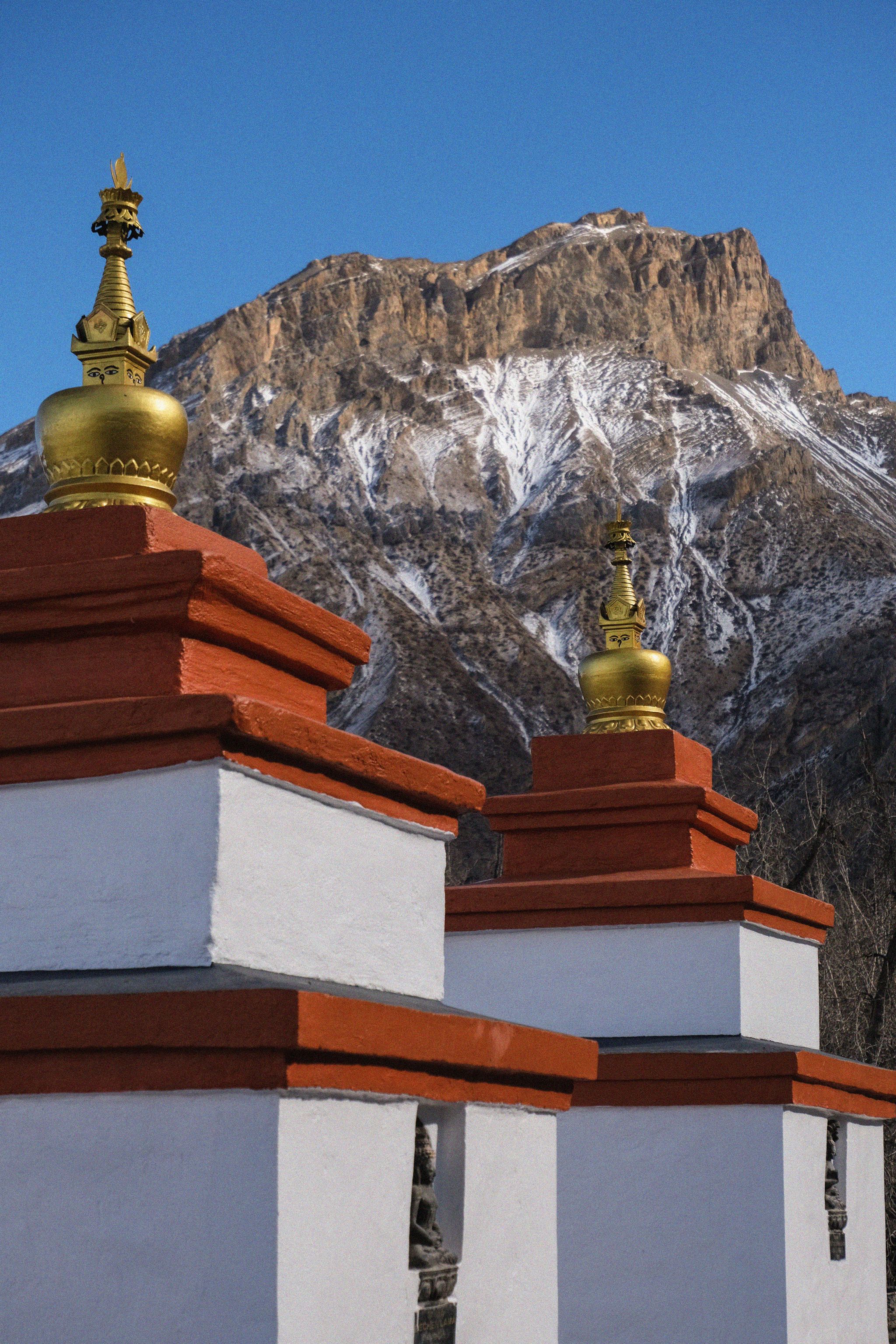
 The hilltop is a compressed universe - votive stupas, prayer wheels, and gilded shrines crowd around the great dome
Practical notes: the monkeys are bold thieves, so hold your sunglasses, snacks, and phone; the steps are steep but broken by rest landings (a road reaches a west-side entrance with fewer stairs); and morning light is best for both the views and the atmosphere, when local devotees make their daily rounds. Entry for foreigners is about NPR 200 - verify current rates.
Boudhanath: the living mandala
Boudhanath is one of the largest stupas on Earth, and from above it forms a giant mandala. At ground level it forms something better: a neighbourhood. The dome anchors the centre of Nepal's Tibetan Buddhist life, ringed by monasteries, thangka studios, butter-tea shops, and rooftop cafes, and the circular street around it fills twice a day with the kora - the clockwise walking circuit that is Boudha's heartbeat.
Come in the last two hours before dusk. Join the flow (clockwise, always), spin the prayer wheels, watch the butter lamps come on, then climb to a rooftop cafe for the view of the dome against the evening sky. Monasteries around the ring welcome respectful visitors, and several hold chanting sessions in the late afternoon that you can quietly observe. Entry is about NPR 400 for foreigners - verify current rates.
The symbolism guide decodes what you are looking at: the eyes, the thirteen tiers, the lungta flags, and why everything moves clockwise.
Doing both in one day
The two sites bracket the city, which makes a natural east-west day:
- Morning: Swayambhunath early (8-9 am beats both heat and crowds), then walk or taxi down into the old town for Durbar Square and the Asan market lanes (the full Kathmandu list).
- Late afternoon: taxi or Pathao ride across town to Boudhanath (30-45 minutes depending on traffic), arriving 4-5 pm for the kora, dusk, and dinner at a rooftop restaurant on the ring.
That order matters: Swayambhunath's magic is morning light and city views; Boudhanath's is dusk. Reversing them halves both.
Etiquette at both
- Walk clockwise around the stupa, always - it is the one rule everyone notices.
- Ask before photographing people in prayer; the monuments are fine to shoot freely.
- Dress modestly - shoulders and knees covered is a safe standard.
- Remove shoes where signs or shoe racks indicate, at chapel and monastery thresholds.
- Spin prayer wheels clockwise with your right hand, and don't climb on anything.
The wider ground rules are in our culture and etiquette guide. For a first-person feel of visiting as a non-Buddhist traveler, this walkthrough covers the kora, the etiquette, and the rooftop views:
Visiting Boudhanath as a foreigner - kora, etiquette and rooftops (Farell & Sheila)Festivals: when the stupas fill
A visit that coincides with a Buddhist festival multiplies everything. Losar (Tibetan New Year, usually February or March) turns Boudhanath into the celebration's Nepali epicentre: fresh prayer flags, masked dances at the surrounding monasteries, and the dome repainted and re-garlanded for the year. Buddha Jayanti (the Buddha's birthday, on the full moon usually falling in April or May) packs both stupas with pilgrims, butter lamps by the thousand, and processions. Both dates follow lunar calendars, so verify the current year before planning around them. On ordinary full-moon days, too, the evening kora at Boudha swells noticeably - a small, reliable upgrade to any visit that happens to line up.
The stupas also carry scars and comebacks worth knowing: the 2015 earthquake cracked Boudhanath's spire, and the community rebuilt it within two years, funded largely by local donations - the reopening in 2016 was itself one of the great kora days in memory. Swayambhunath lost shrines on its periphery in the same quake; restoration continues in places, and watching craftsmen at work is part of the visit.
Beyond the big two
The valley holds more: the smaller Kathesimbhu stupa in the old town (a pocket copy of Swayambhunath), Namobuddha monastery on the valley rim, and Patan's quieter courtyard stupas said to date to Emperor Ashoka. All feature in the valley's UNESCO ensemble, and the day-trips guide covers the rim monasteries.
Kathmandu can overwhelm; the stupas are its antidote. One sits above the noise, one absorbs it into a slow clockwise current, and between them they hold the two halves of the city's soul. Give each its right hour and they will be the memories that outlast the trip.