

Arrive in Nepal in autumn and you may find the country mid-celebration: offices shuttered, goats traveling on bus roofs, kites dueling over rooftops, and every doorway framed in marigolds. Dashain and Tihar are to Nepal what Christmas and New Year are to the West — and understanding them will make an autumn trip dramatically richer.
For 2026, Dashain's main days fall in October, with Tihar following in the first half of November — the dates follow the lunar calendar, so verify the exact days on the current Nepali calendar before locking flights and buses around the peak.
Sending wishes to family and friends? Make a free शुभकामना card with your name in our Dashain & Tihar greeting card maker and share it straight to WhatsApp or Facebook.
Dashain — the fifteen-day homecoming
Dashain is the longest and most important festival in the Nepali calendar, celebrating the goddess Durga's victory over the demon Mahishasura — good over evil. It falls between late September and late October, peaking on the tenth day.
What you will actually see
- The great migration: in the days before the main holidays, the entire country travels home. Kathmandu — normally a city of brutal traffic — empties into something almost peaceful.
- Kites everywhere: Dashain is kite season. Rooftops fill with children (and adults) flying paper kites meant to remind the gods to stop sending rain.
- Bamboo swings (ping): villages erect tall bamboo swings; swinging is said to carry your troubles away with your feet off the earth.
- Animal sacrifice and feasting: goats, ducks, and buffalo are sacrificed to Durga at temples (Gorkha's and Kathmandu's Durbar squares most visibly) and eaten in family feasts. This is central to the festival; sensitive travelers may wish to avoid temple courtyards on the eighth and ninth days.
- Tika day: on Vijaya Dashami (day ten), elders press a thick paste of red vermilion, yogurt, and rice onto the foreheads of younger relatives, with blessings and jamara (sacred barley sprouts). If a Nepali family invites you for tika — a real possibility if you have local friends or a long-stay guesthouse — accept; it is an honor.
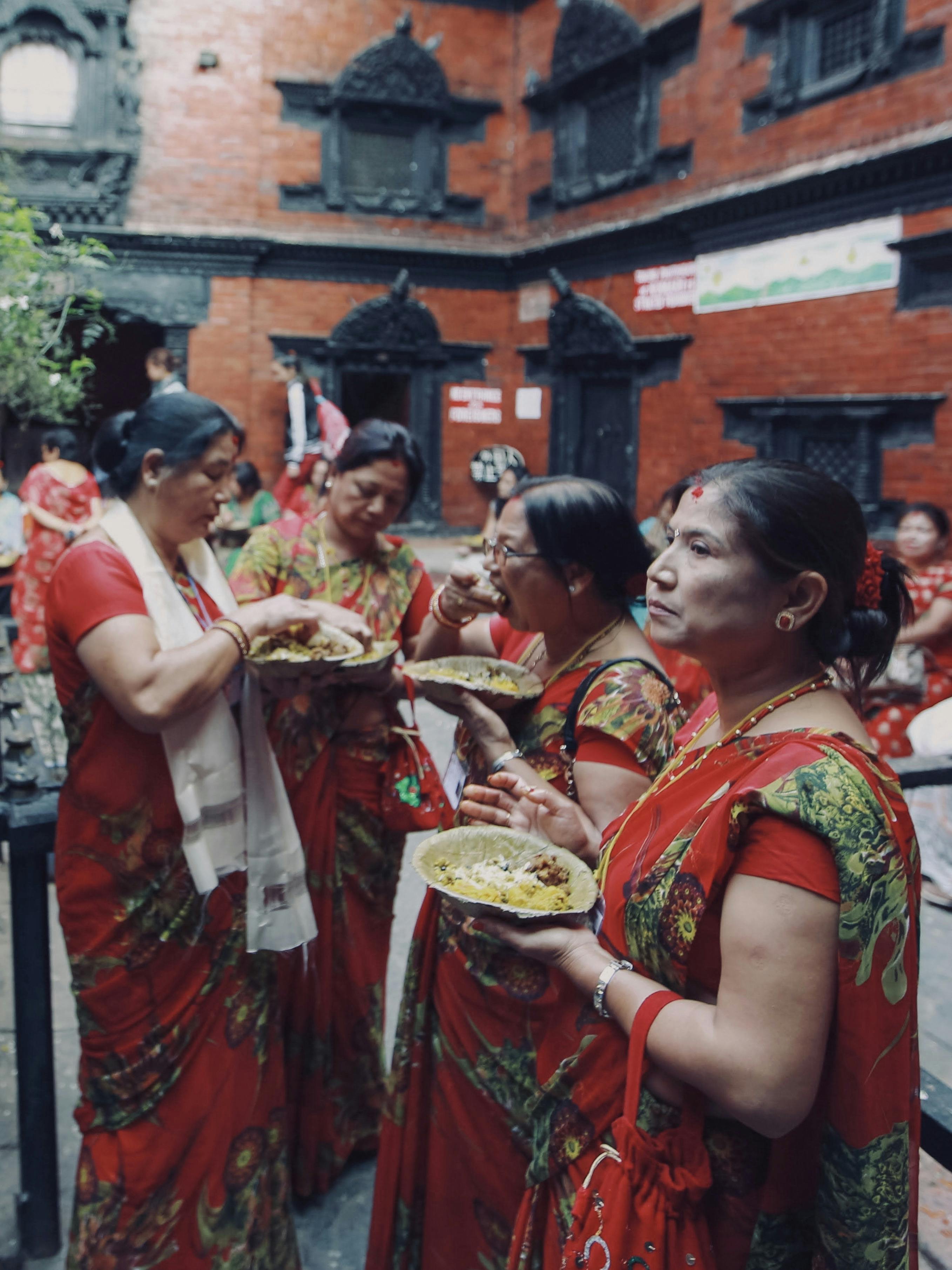 Festival feasting in a Kathmandu Valley courtyard — community meals are central to Dashain
To see what celebrating Dashain inside a Nepali family actually looks like, this vlog follows the festival from tika to feast:
Living the Dashain festival with a Nepali family (Nepali Tanguy Dai)Logistics during Dashain
- Book domestic transport early — buses and flights around the peak days sell out completely.
- Government offices close ~a week, including the immigration and permit offices. Sort visas and trekking permits beforehand.
- Trekking is unaffected on the trail — tea houses stay open (tourism is their Dashain income), and the trails themselves are quieter than usual for peak October.
- Tourist-area restaurants mostly stay open; neighborhood shops may close for the core days.
Tihar — five days of lights
Roughly two weeks after Dashain comes Tihar (also called Deepawali), Nepal's lyrical, glowing answer to Diwali — five days in which animals and siblings are honored in turn.
Day by day
- Kag Tihar — crow day. Offerings of food left on rooftops for the messengers of death.
- Kukur Tihar — dog day. The internet-famous one: every dog in Nepal, from pampered pet to street stray, receives a marigold garland, a tika on the forehead, and treats. It is impossibly charming.
- Gai Tihar & Laxmi Puja — cow day and the night of lights. Cows are honored in the morning; at dusk, every home lights rows of oil lamps and candles to guide Laxmi, goddess of wealth, inside. Children go door to door singing deusi-bhailo — Nepal's carol singing — and the night markets and courtyards of old Kathmandu, Bhaktapur, and Patan are at their most beautiful.
- Goru Tihar / Mha Puja — ox day, and Newar New Year. In the Kathmandu Valley, the Newar community performs Mha Puja, a ritual of self-blessing for the year ahead.
- Bhai Tika. Sisters apply a seven-color tika to their brothers' foreheads and pray for their long life; brothers give gifts in return.
Where to experience it
- Bhaktapur and Patan for lamp-lit medieval squares — the festival's most photogenic settings (guides: Bhaktapur, Kathmandu)
- Any neighborhood at dusk during Laxmi Puja for deusi-bhailo singers and rangoli sand paintings outside doorways
- Everywhere on Kukur Tihar, for the dogs
Tihar closures are shorter than Dashain's — a couple of days — and the festival enhances rather than complicates travel.
Etiquette in short
Ask before photographing rituals or people receiving tika; dress modestly at temples; accept tika and food offered to you with the right hand; and if invited into a celebration, small gifts of fruit or sweets are the right gesture. Nepalis are extraordinarily welcoming during their festivals — meet the welcome with respect and you will collect the best memories of your trip.
Planning around the festivals? See Nepal in October for how Dashain interacts with peak trekking season — and if you are traveling earlier in the year, the late-monsoon festivals Janai Purnima and Gai Jatra are covered in Nepal in August. To get the most from the celebrations, brush up on Nepali culture and traditions and the traditional dress you'll see everyone wearing.


