
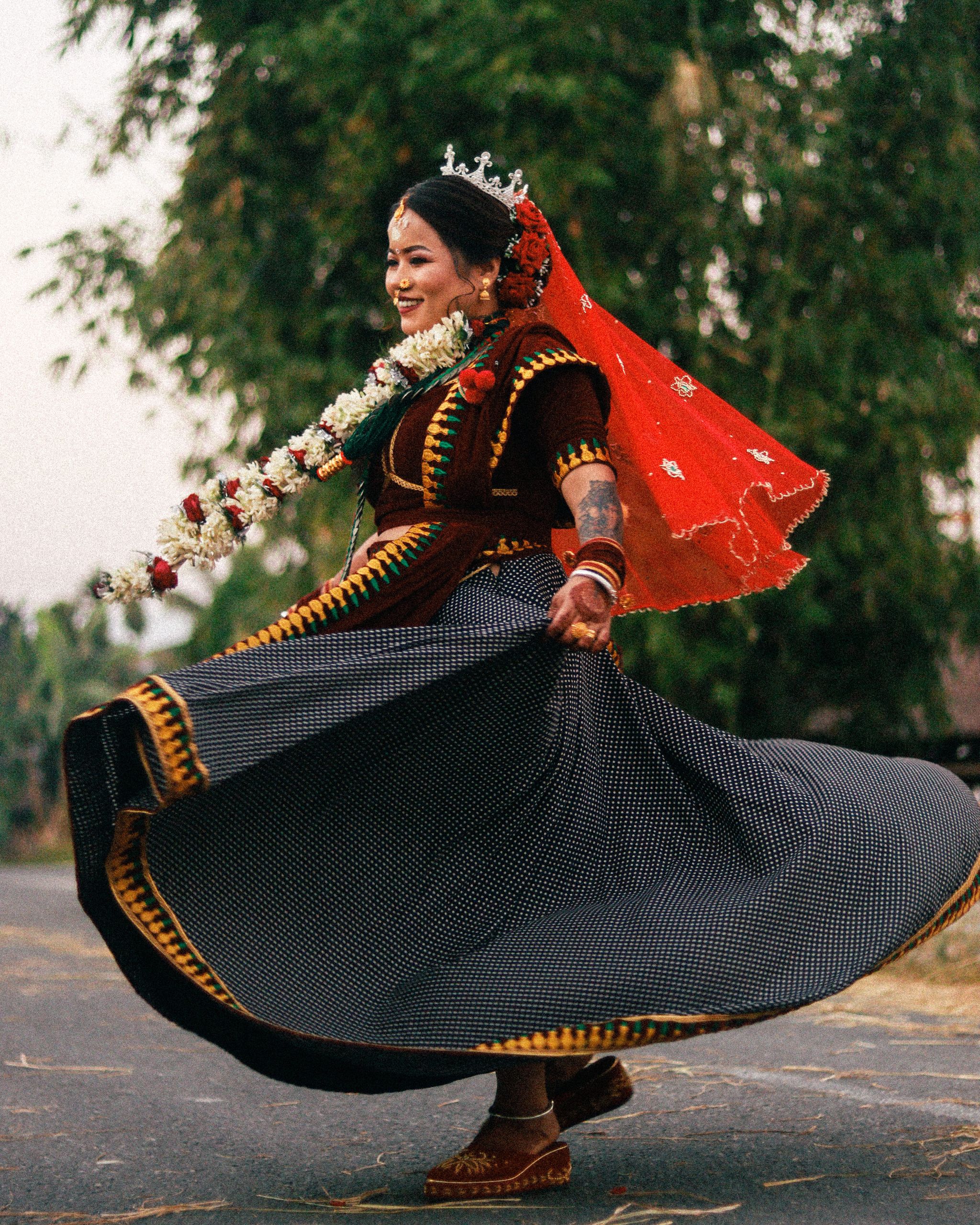
Travel through Nepal during a festival or a wedding and you'll see the country's textile heritage on full display - men in the crisp daura-suruwal topped with a patterned dhaka topi, women in flowing saris and the wrap-skirt gunyu cholo, and entire ethnic communities in costumes you'll find nowhere else. Traditional Nepali dress is both a national identity and a map of the country's diversity. Here's what you're looking at, and what it means.
What is the national dress of Nepal?
Nepal's national dress is the daura-suruwal for men (usually worn with a dhaka topi and, formally, a coat) and the gunyu-cholo for women, though the sari is worn far more widely day to day. Both were formalised as national dress under the Shah kings and remain the standard for festivals, weddings, and official occasions. The sections below break down each garment.
The national dress for men: daura-suruwal
The daura-suruwal is Nepal's best-known traditional outfit. It has two parts:
- The daura - a closed-neck, knee-length shirt that ties at the side, traditionally with eight strings and five pleats, numbers with cultural and religious significance.
- The suruwal - trousers, loose at the top and tapered at the calf.
Over it goes a waistcoat (istakot), and on the head the dhaka topi. For decades this was the formal and official dress; you'll still see it at weddings, festivals, government occasions, and on older men day to day. It pairs national pride with genuine practicality in Nepal's climate.
The dhaka topi and dhaka cloth
The dhaka topi - a brimless cap of handwoven dhaka fabric in bright geometric patterns - is one of Nepal's strongest cultural symbols. No two are quite alike, and a good one is a point of pride. The same dhaka cloth, woven in the eastern hills, is used for shawls and for the women's cholo blouse. Giving a dhaka topi is a gesture of respect, and it's a far more meaningful souvenir than a generic t-shirt.
What women wear
Women's traditional dress is more varied and region-dependent:
- Gunyu cholo - a wrap skirt (gunyu) with a fitted blouse (cholo) and a shawl (patuka) at the waist; traditionally presented to girls at a coming-of-age ceremony.
- Sari with cholo - the draped sari, worn across Hindu communities, especially for formal and festival occasions.
- Kurta-suruwal (kurta surwal) - a long tunic over trousers with a scarf, common everyday formal wear.
Jewellery completes the look - the red tika on the forehead, glass bangles, the pote (green bead necklace) and sindoor worn by married women, and heavy gold for weddings.
Ethnic and regional dress
This is where Nepal's diversity shines. A few you may encounter:
| Group | Distinctive dress |
|---|---|
| Newar | Haku patasi - black sari with a red border; men's tapalan and suruwal |
| Gurung / Magar | Colourful blouses, wrap skirts, beaded jewellery (worn in hill dances) |
| Tharu (Terai) | Bright pleated skirts, bold silver jewellery, tattoos |
| Sherpa (Khumbu) | Tibetan-style chuba robe and the striped pangden apron |
| Tamang | Distinctive headscarves and woven shawls |
You'll see many of these at festivals and cultural dances - the kind of masked and costumed performances that fill the Kathmandu Valley's festival calendar.
Colours, symbols and meaning
Traditional Nepali dress is full of quiet symbolism. Red is the most auspicious colour - the reason brides wear it and why married women apply sindoor (red powder in the hair parting) and a red tika on the forehead. The daura's traditional eight ties and five pleats carry religious significance rather than being merely decorative. The handwoven patterns of dhaka cloth vary by weaver and region, so a topi or shawl often hints at where it was made. Jewellery is meaningful too: the green pote beads and gold tilhari mark a married Hindu woman, and heavy gold is both adornment and a family's portable wealth.
When Nepalis wear traditional dress today
Day to day, most urban Nepalis wear modern Western clothing, and you'll see jeans and t-shirts everywhere in Kathmandu and Pokhara. Traditional dress comes out for the occasions that matter - festivals (especially Dashain and Tihar), weddings, the bratabandha (a boys' coming-of-age rite) and the gunyu cholo ceremony for girls, religious events, and formal or official functions. Older generations and people in rural areas wear it more routinely, and the dhaka topi remains common on men of all ages. Government workers and dignitaries still don the daura-suruwal for state occasions, which keeps it alive as the national dress.
Dress at festivals and weddings
Festivals and weddings are when traditional dress comes out in force. At Dashain and Tihar families wear their finest; brides often wear red (auspicious, not white); and cultural groups perform in full ethnic costume - what actually happens at those weddings, and how to dress if invited, is in our Nepali wedding customs guide. If you're visiting during a major festival - check the dates in our Dashain and Tihar guide - you'll see the textiles at their most spectacular.
Where to see and buy it
The Kathmandu Valley is the best place to both see and buy traditional clothing:
- Markets: Asan, Indra Chowk, and New Road in Kathmandu for daura-suruwal, dhaka topi, dhaka cloth, and saris; Bhaktapur and Patan for Newar styles and crafts.
- Authentic dhaka: look for weaving from Palpa and the eastern hills.
- Tourist shops: Thamel and Pokhara's Lakeside, convenient but pricier; bargaining is expected in local markets - our shopping in Nepal guide covers spotting authentic craft and bargaining fairly.
Buying and even wearing traditional dress is welcomed, not frowned upon - many visitors get a daura-suruwal or sari made for a festival or wedding they're attending. Wear it respectfully and it's a warm gesture. To go deeper on the customs behind the clothing, read our Nepali culture and traditions guide, and see what to wear day to day as a traveler.


