
Access update (August 2026): the August 26 Bhote Koshi flood severely damaged the Rasuwa corridor, including Syabrubesi and the access road toward Dhunche - the gateway for this trek. By late September the Kathmandu-Dhunche road was passable but rough, with Syabrubesi still badly damaged, so the Dhunche-side approach is the realistic one; see our travel update and confirm current access with an agency before planning.
The Gosaikunda trek packs a remarkable amount into a few days: a fast climb from mid-hill forest to a chain of alpine lakes at 4,380 m, one of the most sacred pilgrimage sites in the Himalaya, and a trailhead only a half-day's drive from Kathmandu. And once a year, on the full moon of Janai Purnima (usually August), the trail transforms - tens of thousands of pilgrims and shamans climb to bathe in the freezing holy water. Below: the route day by day, and how the pilgrimage changes everything.
Quick facts
- Duration: 4-6 days out-and-back (7-9 crossing to Helambu; 10-12 with Langtang)
- Highest point: Gosaikunda lake 4,380 m (Laurebina La 4,610 m if crossing)
- Difficulty: Moderate - fast altitude gain is the main risk
- Start/end: Kathmandu → drive to Dhunche/Syabrubesi → trek
- Permits: Langtang National Park entry + TIMS - see the permits guide
- Season: October-November & March-April (August for the pilgrimage)
A sacred lake with a story
Gosaikunda is holy to Hindus and Buddhists alike. In the Hindu telling, Shiva swallowed poison to save the world, and - throat burning - drove his trident into the mountainside to release water; the lake that formed cooled him. A submerged rock near the centre is said to be the remains of a Shiva shrine, and the surrounding basin holds dozens more lakes, traditionally counted as 108. For trekkers this history is not background decoration: the lake's shrine, the prayer flags, and the pilgrim shelters shape the whole experience of arriving.
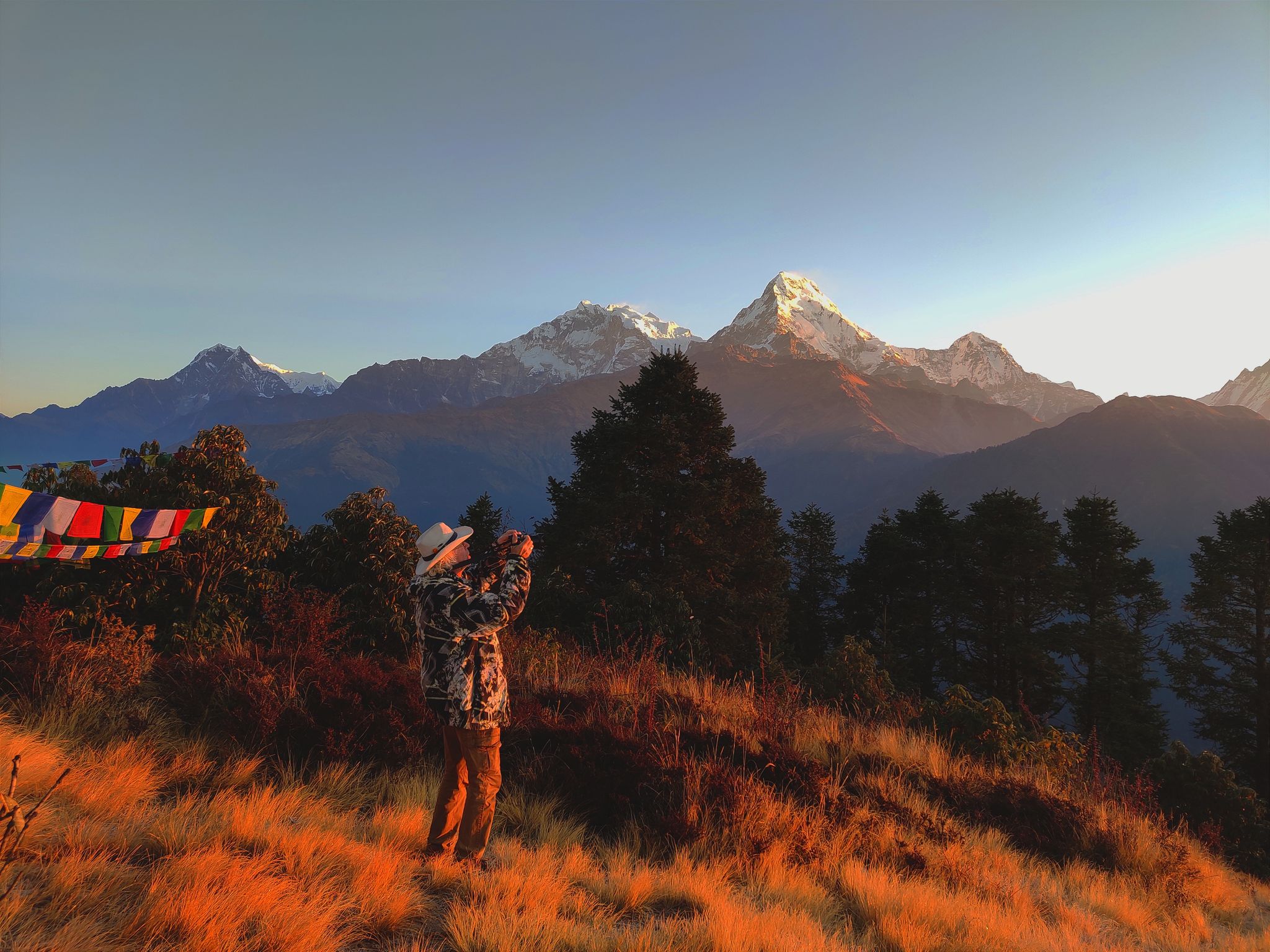
 Prayer flags and pilgrims give Gosaikunda's trail its sacred character
The route, day by day
| Day | Route | Altitude | Hours |
|---|---|---|---|
| 1 | Kathmandu → drive to Dhunche | 1,960 m | 6-7 drive |
| 2 | Dhunche → Sing Gompa (Chandanbari) | 3,250 m | 5-6 |
| 3 | Sing Gompa → Laurebina → Gosaikunda | 4,380 m | 5-6 |
| 4 | Sunrise at the lake → descend to Sing Gompa | 3,250 m | 5-6 |
| 5 | Sing Gompa → Dhunche → drive Kathmandu | 1,960 m | 4-5 + drive |
Strong trekkers cross the Laurebina La (4,610 m) beyond the lake and descend through the Helambu region toward Kathmandu instead of retracing - a quieter, longer exit. Combining Gosaikunda with the Langtang Valley trek makes the region's classic 10-12 day circuit.
Day-by-day notes
Day 2 - Into the forest. From Dhunche the trail climbs steeply through oak and rhododendron to Sing Gompa, home to a small monastery and a famous yak-cheese factory. Watch the altitude: you gain 1,300 m in a day.
Day 3 - Above the clouds. The trees fall away at Laurebina, and on clear mornings the horizon fills with Ganesh Himal, the Langtang range, and on the best days the Annapurnas. The final traverse rounds a ridge to the first lakes - Saraswati Kunda, Bhairav Kunda - before Gosaikunda itself appears in its rocky bowl.
Day 4 - The lake at dawn. Sunrise over the frozen-or-glittering water, a kora (circuit) of the lake past the shrine, then the long descent. Go slowly on day 3 and be ready to turn around if altitude symptoms worsen - the gain here is faster than on most teahouse treks; our altitude sickness guide covers the warning signs.
Janai Purnima: the great pilgrimage
On the full moon of the Nepali month of Shrawan (usually August - verify the current year's date), Gosaikunda hosts one of Nepal's great religious gatherings. Hindu men renew the sacred thread (janai) worn across the chest, pilgrims take a ritual bath in the lake's freezing water, and jhankris - Tamang shamans in feathered headdresses - dance and drum through the night. Tens of thousands make the climb, sleeping in tents and pilgrim shelters.
Trekking during the festival is a trade-off: the monsoon walk-in is wet and the crowds are intense, but you witness something few tourists ever see. Book nothing fancy (lodges overflow), carry rain gear, and treat the event with the respect of a guest - this is a living pilgrimage, not a spectacle staged for visitors. The same full moon is celebrated across the country, as covered in our Nepal in August guide.
Gosaikunda trek from Syabrubesi - 4 days (Steph Thornton Nepal)Permits, cost and practicalities
- Permits: Langtang National Park entry + TIMS, arranged in Kathmandu or at Dhunche.
- Cost: roughly USD 250-450 for an independent 4-6 day trek (permits, teahouses USD 25-35/day, transport), more with a guide - check the current guide requirement, as rules have tightened.
- Getting there: local bus or shared jeep from Kathmandu to Dhunche/Syabrubesi (6-8 bumpy hours) - the region's access details are in our getting around Nepal guide.
- Pack for freezing nights at the lake even in summer; the packing list covers layers.
Best time
Autumn (October-November) and spring (March-April) give the clearest skies and safest trails. August is monsoon - wet and clouded - but it's when Janai Purnima brings the lake to life; go then only if the pilgrimage itself is your goal. Winter turns the lake to solid ice and the upper trail to snow; it's beautiful and empty but demands experience and care.
Close to Kathmandu, rich in both mountain views and living faith, Gosaikunda is one of Nepal's most rewarding short high treks. Pair it with the Langtang Valley for the full region, weigh the season with our best time to visit Nepal guide, and see every route on the Nepal trekking hub.