
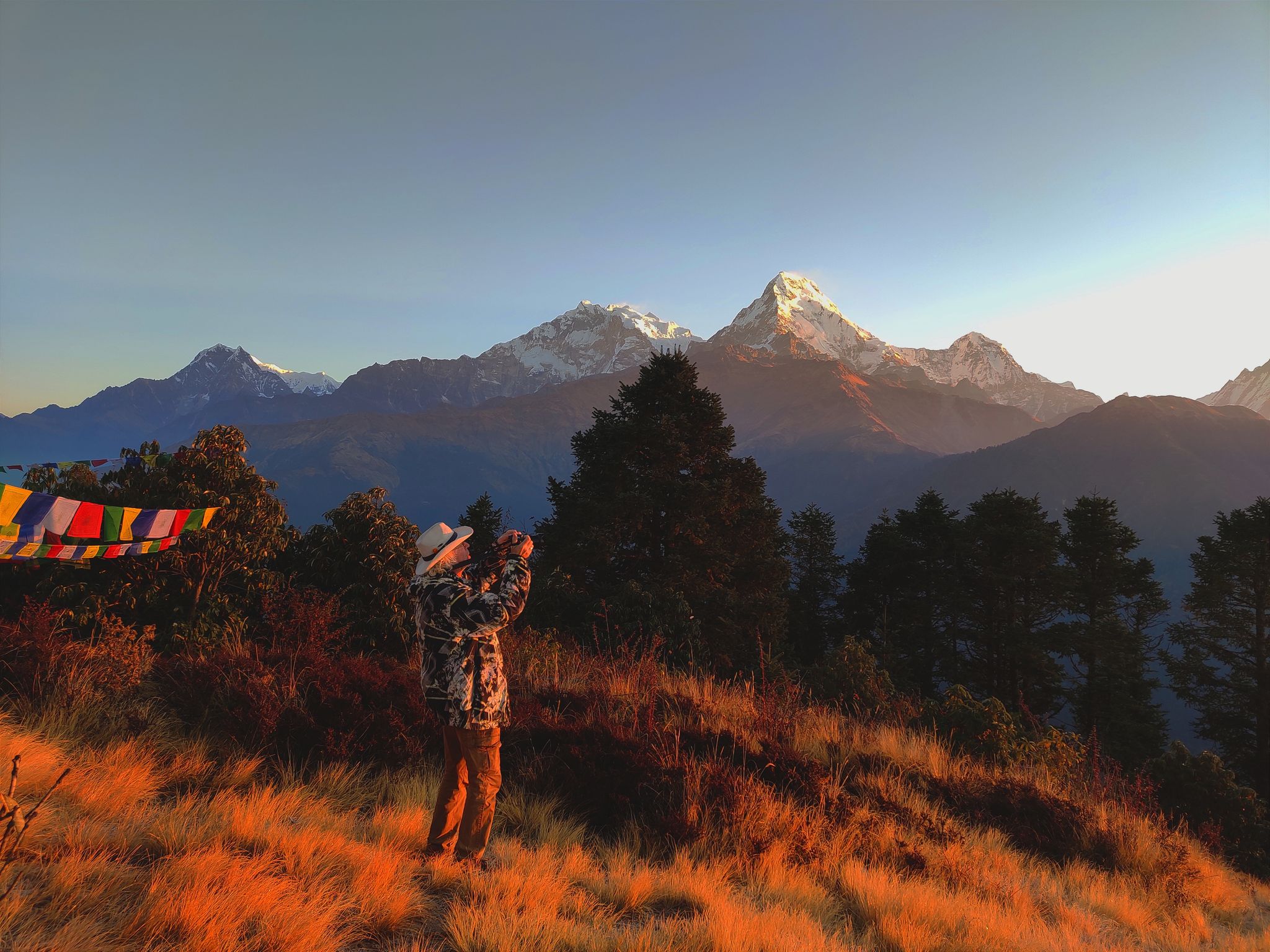
The Poon Hill trek is Nepal's most popular short walk for one good reason: a few days of teahouse trekking through rhododendron forest and stone-stepped villages buys you a sunrise from Poon Hill (3,210 m) with the Annapurna and Dhaulagiri giants strung across the horizon. It's low, well-supported, and achievable for beginners and families, yet it delivers a genuine Himalayan dawn. Close to Pokhara and easy to slot into a wider trip, it's the easiest big-mountain payoff in Nepal. Everything you need is below: the route, the costs, and how to time the dawn.
Quick facts
- Duration: 4-5 days walking (5 with travel from Pokhara)
- Highest point: Poon Hill, 3,210 m
- Difficulty: Easy to moderate - lots of stone steps, but low altitude
- Start/end: Pokhara → Nayapul/Ulleri (drive) → Ghorepani → Ghandruk → Pokhara
- Permits: ACAP + TIMS - see the permits guide
- Season: October-November & March-April
Why trek Poon Hill
Most great Himalayan viewpoints demand a week or more and serious altitude. Poon Hill gives you the sunrise panorama - Dhaulagiri (8,167 m), Annapurna South, Nilgiri, and Machhapuchhre's fishtail - in under a week, topping out below the altitude where sickness becomes a worry. The trail runs through classic middle-hill Nepal: Magar and Gurung villages, terraced fields, and forests that bloom scarlet with rhododendron in spring. It's the standard first trek, a family-friendly option, and an easy add-on to the Annapurna Base Camp trek.
The route, day by day
| Day | Route | Altitude | Hours |
|---|---|---|---|
| 1 | Pokhara → drive to Nayapul → Tikhedhunga/Ulleri | 1,960 m | 1-2 drive + 4-5 walk |
| 2 | Ulleri → Ghorepani (the big stone staircase) | 2,870 m | 5-6 |
| 3 | Sunrise at Poon Hill → Tadapani | 3,210 m / 2,630 m | 6-7 |
| 4 | Tadapani → Ghandruk → drive Pokhara | 1,940 m | 4-5 + drive |
Many trekkers add a day, or extend from Ghorepani toward the Annapurna Base Camp or Mardi Himal routes for a longer trip.
Day-by-day notes
Day 1 - Into the foothills. Drive from Pokhara to the Nayapul trailhead, then walk along the river and up to Ulleri or Tikhedhunga, easing into the rhythm through farmland and small villages.
Day 2 - The staircase to Ghorepani. The trek's signature challenge: a long climb of thousands of stone steps up to Ghorepani, a ridge village of blue-roofed lodges. Take it slow; the rhododendron forest here is glorious in spring.
Day 3 - The sunrise. A pre-dawn walk up to Poon Hill for the main event - the sun igniting Dhaulagiri and the Annapurnas one by one. Back for breakfast, then on through mossy forest to Tadapani.
This trek video walks the route - the staircases, Ghorepani, and the summit dawn:
Annapurna Base Camp via Poon Hill - the route on video (Nepal Mother House Treks)Day 4 - Down through Ghandruk. Descend to the beautiful Gurung village of Ghandruk, with its stone houses and mountain backdrop, then drive back to Pokhara.
Who the Poon Hill trek is for
This is the trek to choose if you're short on time, new to trekking, or travelling with children or older relatives (our older-travelers guide covers the comfort-first version). The low high-point keeps altitude out of the equation, the teahouses are comfortable and frequent, and you're never more than a day or two from a road. It's also a smart acclimatisation warm-up before a bigger objective, and a reliable bad-weather alternative when higher routes are snowed in. The one thing it asks of everyone is leg fitness for the stone staircases - there's a lot of up and a lot of down, even if the air stays thick.
Tips for the Poon Hill sunrise
- Start in the dark. The walk up from Ghorepani takes around 45-60 minutes; leave with a headlamp roughly an hour before sunrise so you're at the top with time to spare.
- There's a small entry fee at the Poon Hill gate, payable in cash - carry rupees.
- Dress for cold then warm. Pre-dawn at 3,210 m is freezing even in autumn; you'll shed layers fast once you've walked back down for breakfast.
- Check the forecast and be flexible. A clouded-out morning happens; if your schedule allows a buffer night in Ghorepani, you can try again the next dawn.
- Bring a warm drink. The teahouses fill flasks early, and a hot tea while the peaks ignite is part of the experience.
Permits and cost
- Permits: ACAP + TIMS, arranged in Pokhara or Kathmandu with passport and photos.
- Cost: roughly USD 200-400 for an independent 4-5 day trek (permits, teahouses USD 20-30/day, transfers), more with a guide or porter. Cash only on the trail.
- Guide: optional given the easy, well-marked trail, though guide rules for solo trekkers have tightened - verify the current requirement.
- Pack light layers plus something warm for the cold pre-dawn summit; see the packing list.
Best time
Autumn (October-November) and spring (March-April) are the windows - clear dawns and, in spring, the rhododendron bloom that makes Ghorepani famous. Winter is quiet with possible snow up top; the monsoon hides the peaks. For the full month-by-month picture see Nepal in October.
Short, low, and scenic, Poon Hill is the perfect introduction to Himalayan trekking - or a gentle add-on to a bigger trip. Compare it with the Annapurna Base Camp and Mardi Himal treks, explore the wider Annapurna region, and see every route on the Nepal trekking hub.


