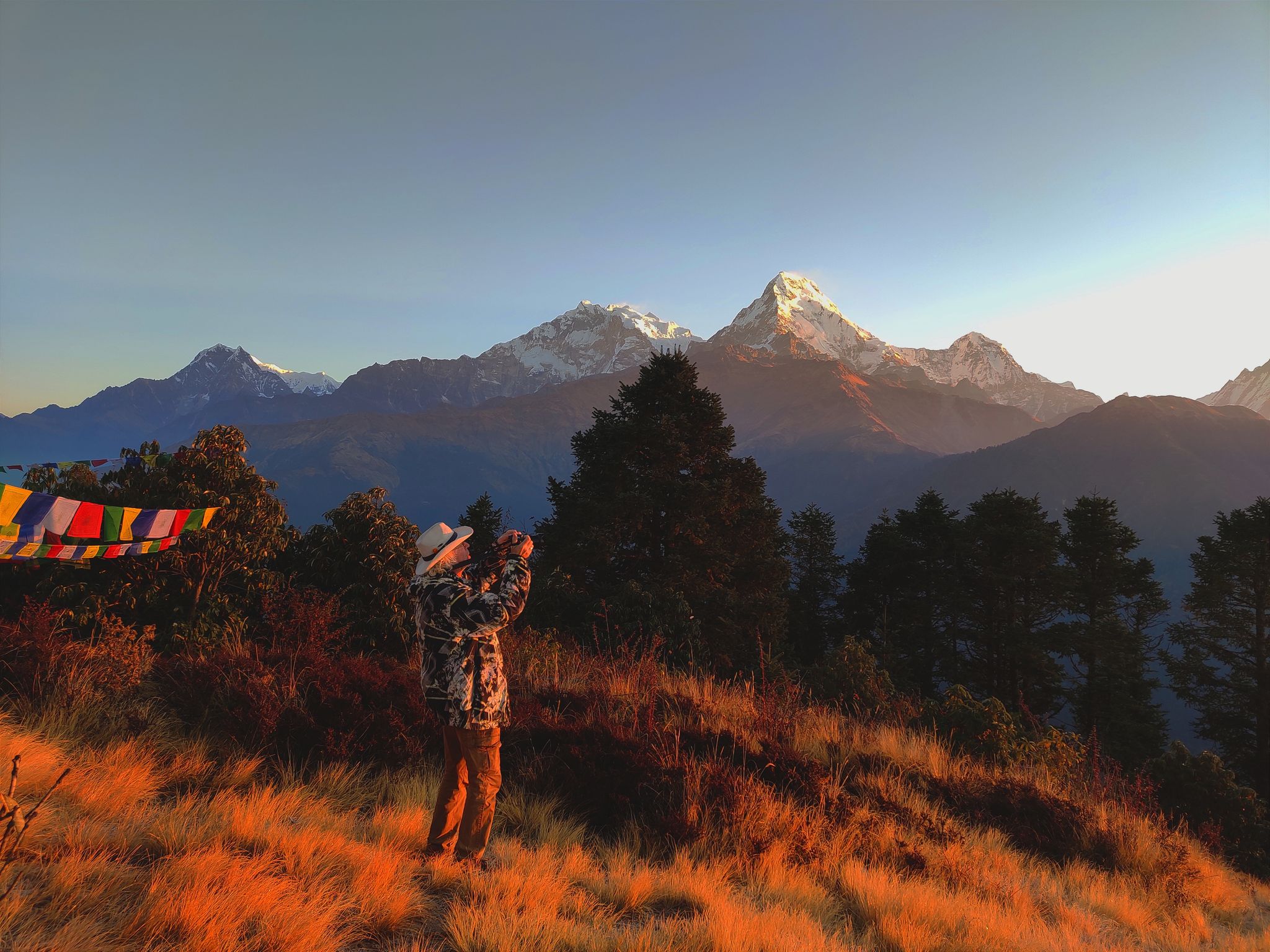

If you want to stand in the middle of a ring of Himalayan giants without a two-week commitment, the Annapurna Base Camp trek is the one. It walks you straight into the Annapurna Sanctuary - a glacial amphitheatre encircled by peaks over 7,000 and 8,000 metres, with Annapurna I (8,091 m) towering at its head. Accessible from Pokhara, teahouse-supported and moderately challenging, ABC is one of Nepal's most rewarding shorter treks. The full route table is below, along with the costs, the permits, and the days as they actually unfold.
Quick facts
- Duration: 7-12 days from Pokhara
- Highest point: Annapurna Base Camp, 4,130 m
- Difficulty: Moderate (long days, lots of steps)
- Start/end: Pokhara → Nayapul / Jhinu / Kande (jeep), and back
- Permits: ACAP + TIMS - see the permits guide
- Season: October-November & March-April
The route, day by day
| Day | Route | Altitude | Hours |
|---|---|---|---|
| 1 | Pokhara → drive to trailhead → Jhinu/Chhomrong | ~2,170 m | 2-3 drive + 4-5 walk |
| 2 | Chhomrong → Bamboo | 2,310 m | 5-6 |
| 3 | Bamboo → Deurali | 3,200 m | 5-6 |
| 4 | Deurali → MBC → Annapurna Base Camp | 4,130 m | 5-6 |
| 5 | Sunrise at ABC → descend to Bamboo | 2,310 m | 6-7 |
| 6 | Bamboo → Jhinu Danda (hot springs) | 1,780 m | 5-6 |
| 7 | Jhinu → trailhead → drive Pokhara | 820 m | 4 walk + drive |
Add 2-3 days at the start to include the Poon Hill / Ghorepani sunrise loop via Ghandruk - a popular, scenic extension.
Day-by-day notes
Day 1 - Into the foothills. Jeep from Pokhara to the trailhead, then climb through terraced villages to Chhomrong, the large Gurung village that's the gateway to the Sanctuary, with Annapurna South and Machhapuchhre (the sacred "Fishtail") filling the sky.
Day 2 - Chhomrong to Bamboo. A knee-testing descent and climb into the steep, forested upper gorge - bamboo and rhododendron, waterfalls, and the valley narrowing around you.
Day 3 - Bamboo to Deurali. Climbing steadily out of the tree line into the high, enclosed valley that funnels you toward the Sanctuary. The air cools and thins.
Day 4 - Into the Sanctuary. Past Machhapuchhre Base Camp (MBC) and up to Annapurna Base Camp itself - stepping into the amphitheatre of peaks is one of trekking's great reveals. Spend the afternoon among the prayer flags and memorials as the light moves across Annapurna I.
Day 5 - Sunrise, then down. Wake early for dawn igniting the surrounding peaks, then begin the long descent.
Days 6-7 - Hot springs and out. Drop to Jhinu Danda and soak tired legs in its riverside hot springs before the final walk out and the drive back to Pokhara.
To see the trail - the stone staircases, the gorge, and the walk into the Sanctuary - this solo trek vlog covers the full route:
Annapurna Base Camp solo trek, unfiltered (lexlimbu)Why choose ABC
- Maximum mountains, less time - you're surrounded by 360° of giants at the end, in a week rather than two.
- No expensive flights - it starts near Pokhara, keeping costs down.
- Variety - terraced farmland, deep forest gorge, high glacial basin, and a hot-spring finish.
- Add-on friendly - bolt on the Poon Hill sunrise loop, or use it as a first taste before the Annapurna Circuit.
Want something shorter and quieter in the same region? The Mardi Himal trek is the four-to-five day ridge alternative under Machhapuchhre. Deciding between the big two? Read EBC vs the Annapurna Circuit, and see all routes on the Nepal trekking hub.
Permits, cost and practicalities
- Permits: ACAP (Annapurna Conservation Area) + TIMS, arranged in Pokhara or Kathmandu - passport and photos needed.
- Cost: ~USD 500-900 independent; more with guide/porter. Cash only on the trail.
- Altitude: lower than EBC, but 4,130 m is still real - ascend steadily and don't skip the gradual gain.
- Avalanche awareness: the section above Deurali can be avalanche-prone after heavy snow; heed local advice in winter and early spring.
- Pack for the full range - hot lower valleys to freezing base camp; see the packing list.
Best time
Autumn (October-November) and spring (March-April) deliver the clearest views; spring adds the famous rhododendron bloom on the lower trail. Avoid the monsoon for views and safety.
Short enough for a two-week holiday, spectacular enough to rival anything in the Himalaya - the Annapurna Base Camp trek is the sweet spot of Nepal trekking. Base yourself in Pokhara, sort your permits, and walk into the Sanctuary.