Most people walk into Namche Bazaar on day two of the Everest trek with heavy legs and a mild headache, having gained more than 800 m since Phakding that morning. The next morning, the itinerary says "rest day." It isn't one. The Namche Bazaar acclimatization day is a hike, 400-500 m up and back down again, and how you spend it decides how you feel at Dingboche and Lobuche a week later. This guide covers the classic loop with timings, and the shorter and longer alternatives.
Why the Namche acclimatization day matters
Namche sits at 3,440 m. Above about 3,000 m the standard rule is to raise your sleeping altitude by no more than 300-500 m a day and to take an extra night for every 1,000 m or so of gain. Lukla to Namche already breaks the rhythm, so the second night here is where your body catches up.
Climbing higher during the day and then sleeping low pushes that adaptation along. Lying in your room all day doesn't, and neither does marching to the next village. The goal is a few hours of gentle walking to around 3,800-3,900 m, then back down for lunch and a quiet afternoon. The altitude sickness guide explains the physiology and the warning signs.
The classic loop: Everest View Hotel and Khumjung
This is the hike nine out of ten guides will lead, and it is the right one. It climbs to the first proper view of Everest, then drops through the two biggest Sherpa villages in the Khumbu on the way back.
| Stage | Altitude | Time |
|---|---|---|
| Namche Bazaar, climb out of the top of town | 3,440 m | start |
| Syangboche airstrip | ~3,750 m | 1-1.5 hours |
| Hotel Everest View, terrace and tea | 3,880 m | 30-45 minutes |
| Down through juniper to Khumjung | ~3,790 m | 30-45 minutes |
| Khunde and back (optional) | ~3,840 m | 30-40 minutes |
| Khumjung back to Namche | 3,440 m | 1-1.5 hours |
Plan on four to six hours with stops. Start by eight; Khumbu mornings are clear and the cloud usually rolls up the valley by late morning, taking the view with it.
The first hour is the hardest part of the day: a steep zigzag from the top of Namche to the dusty Syangboche airstrip, used mostly by helicopters now. Go slowly enough to talk. From there the trail flattens along the ridge to the Hotel Everest View, a stone lodge built for the view and priced accordingly. Buy a tea or coffee and take your time on the terrace. Everest's summit pokes over the Nuptse-Lhotse wall to the northeast, with Ama Dablam to its right and Thamserku and Kangtega close across the valley.
 From the ridge above Namche: Ama Dablam in the centre and the Lhotse wall on the left, the view the climb is for
From the hotel a path drops through juniper and rhododendron to Khumjung, a broad village of stone houses and potato fields under the sacred peak of Khumbila. Its gompa keeps what is said to be a yeti scalp in a glass case, shown for a small donation. The school at the edge of the village was founded by Edmund Hillary in 1961 and is still teaching Sherpa children. If you have energy, walk 20 minutes west to Khunde, where the hospital set up by Hillary's Himalayan Trust still serves the whole region.
The way back to Namche contours round the hillside and drops past the airstrip again, about an hour and a half. You'll be back by early afternoon with 450 m of climbing in your legs, which is exactly the point.
Acclimatisation day in Namche: Khumjung Monastery and the Hotel Everest View (TRAVRIST)The short version: the park headquarters viewpoint
If you woke with a headache or slept badly, don't do the full loop. Walk up instead to the Sagarmatha National Park headquarters on the ridge east of town, 20-30 minutes above the top lodges. On a clear morning the view is almost the same one as from the hotel: Everest, Lhotse, Ama Dablam, and the trail you'll walk to Tengboche tomorrow, cut into the hillside below. The small visitor centre explains the park, and the Sherpa Culture Museum is a few minutes away. Gaining 100-150 m and coming back down still helps, and it leaves you rested.
If the headache is still there after a gentle hour and some water, that's a reason to stay a second night, not to push on.
The long version: Thame
Strong walkers who arrived in Namche feeling fine sometimes go west up the Bhote Koshi valley to Thame (3,820 m), the village where Tenzing Norgay grew up, with an old gompa on the hillside above it. It is a quieter, wilder valley than the main trail, and there's no Everest view. Out and back it is a long day of 6-7 hours. Unless you're already acclimatized from another trek, it is a better overnight on a longer itinerary than a rest-day outing; the Three Passes trek comes down this valley from the Renjo La.
The rest of the day in Namche
Afternoons in Namche are for eating and lying still. The town is the biggest in the Khumbu, built in a horseshoe of lodges stepping up the hillside, and it has things you won't see again until you come back down: bakeries with real coffee, gear shops for the down jacket you didn't pack, pharmacies, and a couple of ATMs that work some of the time. Take cash out if you can, because there is nothing reliable above here. The EBC cost guide has the daily budget.
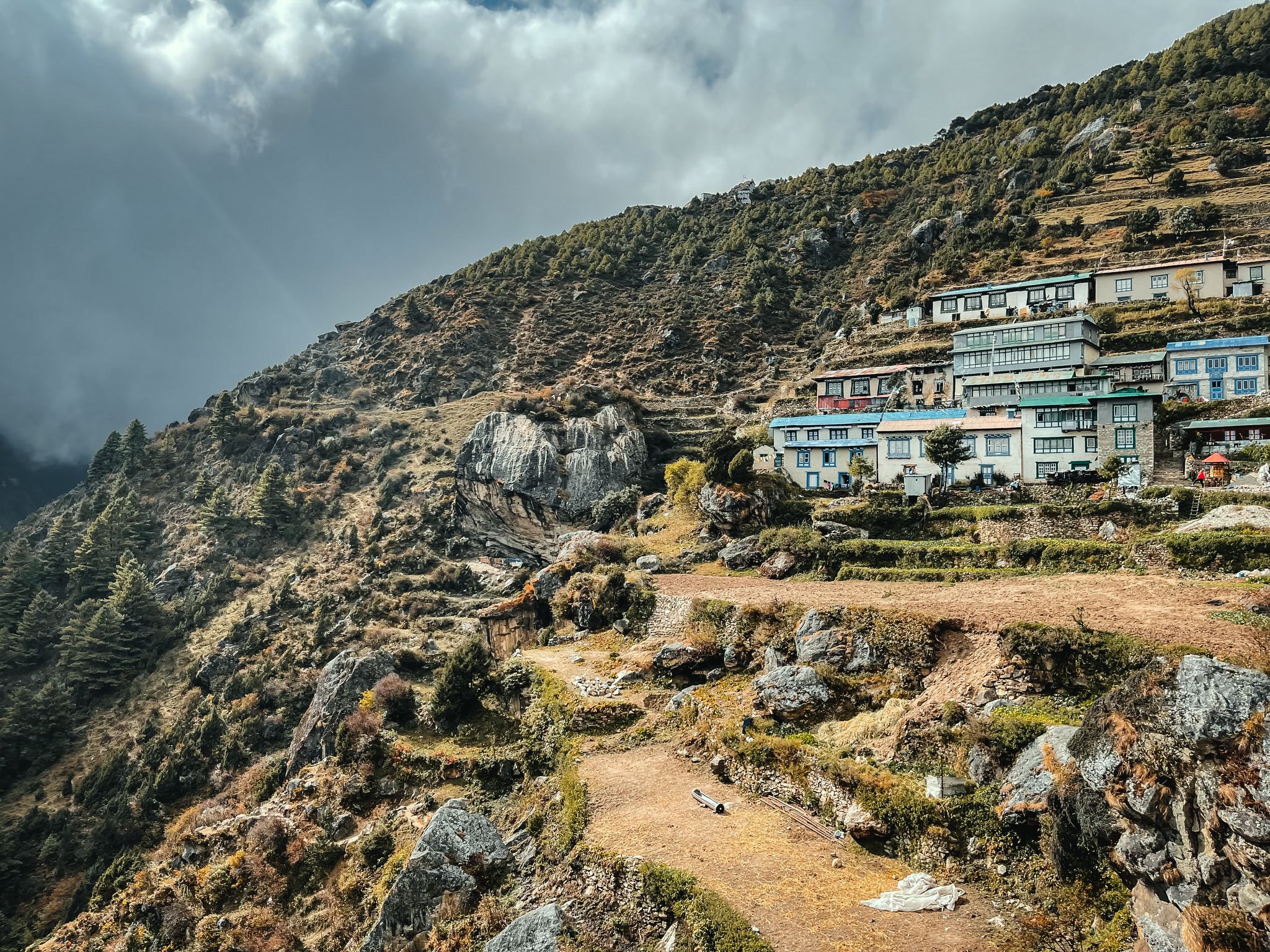
 Namche's stupa and the lodges stacked up the bowl behind it; cloud like this by early afternoon is normal
If your rest day falls on a Saturday, walk down to the weekly market, where porters and traders from the lower valleys sell rice and vegetables carried up on their backs. It's busy and noisy and it shows how the whole Khumbu is supplied.
A few things to skip. Alcohol on the acclimatization day is a bad idea, however tempting the bars on the main street look. Long naps can make the night's sleep worse, so keep them short. And don't be talked into continuing to Tengboche the same afternoon to "save a day"; it saves nothing if you spend two of them later with a headache.
Where it fits in the trek
On the standard 12-day EBC itinerary this is day 3, after Phakding and before Tengboche, and the second acclimatization day comes at Dingboche on day 6. The EBC and Gokyo Lakes route uses the same day before turning up the Gokyo valley. Either way, the habit you build here (slow walking and an honest look at how you feel each morning) is what gets you to 5,000 m. For the villages above Namche and the region in general, the Everest region guide is the next read, and the Nepal trekking guide puts the whole route in context with the country's other treks.
Then sleep early. Tomorrow's walk to Tengboche drops 300 m to the river and climbs 600 m back up to the monastery.