Most people who walk to Everest Base Camp never see the best view in the Khumbu. It is 20 kilometres west, from the top of Gokyo Ri, where four 8,000-metre peaks line the horizon above a chain of turquoise lakes. The Everest Base Camp and Gokyo Lakes trek joins the two in one loop, linked by the Cho La, a 5,420 m glacier pass. Sixteen days, one flight in and out of Lukla, both signature mornings, and one glacier pass. This is the route day by day, with the altitudes, the direction question, the pass itself, and the costs.
Quick facts
- Distance: roughly 150 km, Lukla to Lukla
- High points: Kala Patthar 5,545 m, Cho La 5,420 m, Gokyo Ri 5,357 m
- Highest sleeping point: Gorak Shep, 5,164 m
- Nights above 4,500 m: six
- Duration: 16 days from Lukla, 19-20 with Kathmandu and buffer days
- Season: October to November, March to May; the pass is a serious undertaking in winter
- Permits: Sagarmatha National Park entry plus the Khumbu municipality fee, bought at Lukla or Monjo; no TIMS here (permits guide)
Which way round
There are two ways to walk the loop and the choice matters more than it looks. Gokyo first climbs the quieter western valley in gentle 300-400 m steps, gives you Gokyo Ri as an acclimatisation summit, and sends you over the Cho La rested, before Base Camp and Kala Patthar close the trek. Base Camp first follows the classic EBC trail, then crosses the pass from Dzongla after your highest and coldest nights, with Gokyo as the finale. Many agencies sell the second because it is easier to combine with helicopter returns from Gokyo. For acclimatisation, the first is the better plan, and it is the one in the table below. Our Gokyo vs EBC comparison explains why the two valleys feel so different.
The route, day by day
| Day | Route | Sleep at | Hours |
|---|---|---|---|
| 1 | Fly to Lukla (2,860 m), walk to Phakding | 2,610 m | 3-4 |
| 2 | Phakding to Namche Bazaar | 3,440 m | 6-7 |
| 3 | Acclimatisation day: Everest View Hotel or Khumjung | 3,440 m | 3-4 |
| 4 | Namche to Dole via Mong La (3,970 m) and Phortse Tenga | 4,200 m | 6-7 |
| 5 | Dole to Machhermo | 4,470 m | 4-5 |
| 6 | Machhermo to Gokyo, past the first two lakes | 4,790 m | 4-5 |
| 7 | Gokyo Ri (5,357 m) at dawn; fourth and fifth lakes in the afternoon | 4,790 m | 5-7 |
| 8 | Gokyo across the Ngozumpa Glacier to Thagnak | 4,700 m | 3-4 |
| 9 | Thagnak over the Cho La (5,420 m) to Dzongla | 4,830 m | 7-9 |
| 10 | Dzongla to Lobuche, joining the EBC trail | 4,910 m | 3-4 |
| 11 | Lobuche to Gorak Shep, then Everest Base Camp (5,364 m) and back | 5,164 m | 7-8 |
| 12 | Kala Patthar (5,545 m) at dawn, descend to Pheriche | 4,240 m | 7-8 |
| 13 | Pheriche to Tengboche | 3,860 m | 5-6 |
| 14 | Tengboche to Namche | 3,440 m | 5-6 |
| 15 | Namche to Lukla | 2,860 m | 6-7 |
| 16 | Fly to Kathmandu (morning flights only) |
Day 4 is the one jump that breaks the 400 m rule, from Namche to Dole. If you felt the altitude in Namche, sleep at Phortse Tenga (3,680 m) and add a day; the valley above has lodges at every stage and the extra night costs little.
Up the Gokyo valley: days 4 to 7
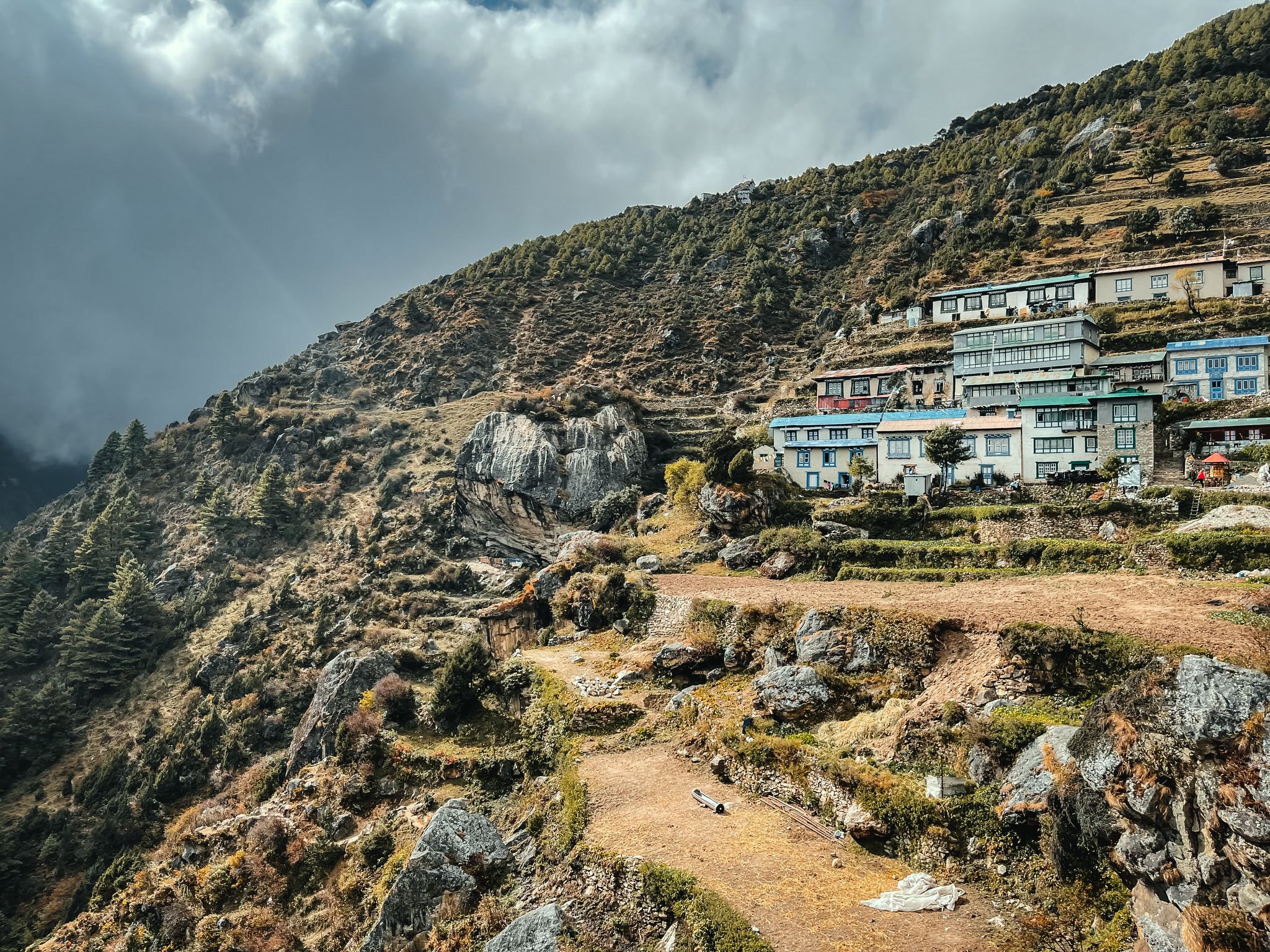
Above Mong La the crowds vanish. The trail drops to the river at Phortse Tenga, then climbs through rhododendron and juniper into yak country, with Cho Oyu (8,188 m) filling the head of the valley by Machhermo. The lakes begin on day 6: the first two are small and milky, the third is Gokyo's, and the village sits on its shore in one of the best positions in the Himalaya.
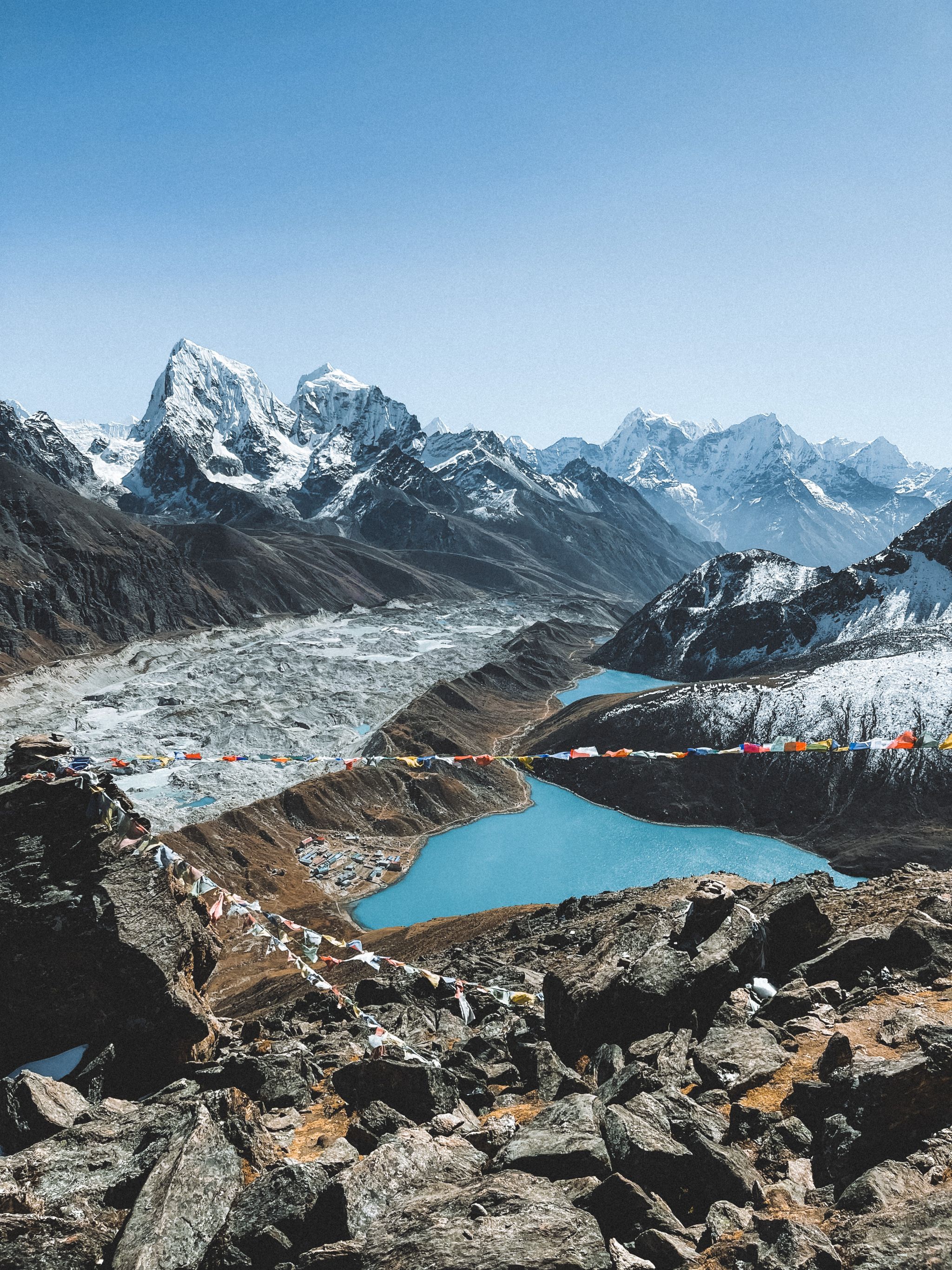
 Gokyo from the ridge: the village on the third lake, the Ngozumpa Glacier's grey moraine behind it
Day 7 is the day you came for. The climb up Gokyo Ri takes two to three hours from the village, and the summit looks across the lakes and the grey river of the Ngozumpa Glacier, Nepal's longest, to Everest, Lhotse, Makalu, and Cho Oyu in a single sweep. Go at dawn for the light on Everest, then spend the afternoon walking up the valley to the fourth and fifth lakes, which almost nobody visits. Both outings count as acclimatisation for the pass.
The Cho La: days 8 and 9
Day 8 is short and strange: a marked route across the Ngozumpa Glacier's rubble, dropping into hollows between moraine walls and climbing out again, to the handful of lodges at Thagnak. Sleep early.
The pass day starts in the dark. From Thagnak the trail climbs a steep scree valley to a boulder field, then a short rock scramble lands you on the glacier that fills the top of the pass. In dry conditions it is a flat, cracked walk of twenty minutes to the prayer flags at 5,420 m, with Ama Dablam appearing to the east. After snow it is a different place: the glacier needs microspikes and the boulders ice over, and the long descent on the Dzongla side, down loose rock to a grassy valley, turns slow and careful. Lodges on both sides know the day's conditions and whether anyone has crossed; ask the night before, and if the answer is no, wait a day. Dzongla's handful of lodges at 4,830 m are the reward, with Cholatse rising straight above them.
The Gokyo and Cho La crossing to Base Camp, filmed on the route (goExplore)If the pass closes for more than a day, the fallback is to retreat to Gokyo and walk down to Phortse, then across to Pangboche and up to Dingboche, two days instead of one, rejoining the plan at Lobuche.
Base Camp and Kala Patthar: days 10 to 12
From Dzongla a gentle three hours across the hillside brings you to Lobuche and the main EBC trail, suddenly busy after the solitude of the west. The next two days are the classic finish described in the 12-day EBC itinerary: Gorak Shep, the moraine walk to Base Camp, a cold night at 5,164 m, and the pre-dawn climb of Kala Patthar for the sunrise view of Everest's southwest face. Then the long descent to Pheriche's thicker air, which is the best night's sleep of the trek.
The walk out: days 13 to 16
Three descending days through Tengboche and Namche to Lukla. Legs are tired and lungs are grateful. Build at least one buffer day before your international flight, two in peak season, because Lukla's weather holds are routine and the autumn departures run from Ramechhap, a 4-5 hour drive from Kathmandu.
What it costs
Four extra days on the EBC budget plus the pass. Independent trekkers should plan on roughly USD 1,400-1,800 all-in from Kathmandu, with a guide and shared porter about USD 2,100-2,600, and agency packages USD 1,900-3,000 per person. The EBC cost breakdown lists every line, and all of it applies here with four more days of food, beds, and wages. Carry cash for the whole trek; Namche is the last ATM, and an unreliable one.
When to go
October and November give the most stable weather on the pass; March to May adds expedition-season energy at Base Camp and more afternoon cloud. December to February is for experienced parties only, with the Cho La often closed after storms, and the monsoon rules out the pass altogether. October is the sweet spot, with the caveat that lodges in Gokyo and Dzongla fill early.
Before you book
Train for consecutive days, not single long hikes (training plan), read the altitude sickness guide until the descent rule is reflex, check that your insurance covers 5,545 m and helicopter evacuation, and book the Lukla legs through whoever arranges your guide. If sixteen days is too many, the 12-day EBC itinerary or the Gokyo valley on its own keeps one signature view; if it is too few, the Three Passes trek adds the Renjo La and Kongma La for the full Khumbu circuit. The Everest region guide covers the villages you will sleep in along the way, and the Nepal trekking guide shows where this loop sits among the country's other long routes.