
Every trekker headed for the Khumbu faces the same fork in the trail - literally, a junction above Namche Bazaar. Left climbs the quiet Dudh Koshi valley to the turquoise lakes of Gokyo; right follows the crowds up the classic highway to Everest Base Camp. Both are magnificent. They are also genuinely different treks, and the right choice depends on what you actually want from your two weeks - so let's put them side by side.
The two routes at a glance
| Gokyo Lakes | Everest Base Camp | |
|---|---|---|
| Days (Lukla return) | 11-12 | 12-14 |
| High point | Gokyo Ri, 5,357 m | Kala Patthar, 5,545 m |
| Signature sight | Turquoise lakes + 4× 8,000ers | Everest close-up, Khumbu Icefall |
| Crowds | Moderate | Heavy in season |
| Teahouses | Good, simpler | Most developed in Nepal |
| Trail character | Quieter valley, gentler stages | Busy, social, well-marked |
Both begin identically: the Lukla flight, two days to Namche Bazaar (3,440 m), and the essential acclimatisation day there. The routes split a morning above Namche and rejoin only if you cross a pass.
The case for Gokyo
The Gokyo valley is the Khumbu with the volume turned down. Beyond Mong La the trail drops into a quieter drainage through Dole and Machhermo, following yak pastures rather than convoy traffic, and arrives at a chain of glacial lakes of an almost implausible turquoise beneath Cho Oyu. Gokyo village sits on the third lake's shore - one of the most beautifully positioned settlements in the Himalaya.
The payoff climb is Gokyo Ri (5,357 m), and its summit panorama is the best-kept open secret in the region: the lakes below, the grey river of the Ngozumpa Glacier (Nepal's longest), and on the horizon four 8,000-metre peaks at once - Everest, Lhotse, Makalu, and Cho Oyu. Kala Patthar cannot match that breadth. Sunset and dawn both work; the lakes hold their colour best in mid-morning light.
 Gokyo village on the third lake, with Cho Oyu - the world's sixth-highest mountain - filling the head of the valley
What Gokyo lacks: the name. Nobody's colleagues have heard of it, there is no "I stood at Base Camp" moment, and the teahouses, though good, are a notch simpler than the EBC corridor's espresso-machine standard.
The case for Everest Base Camp
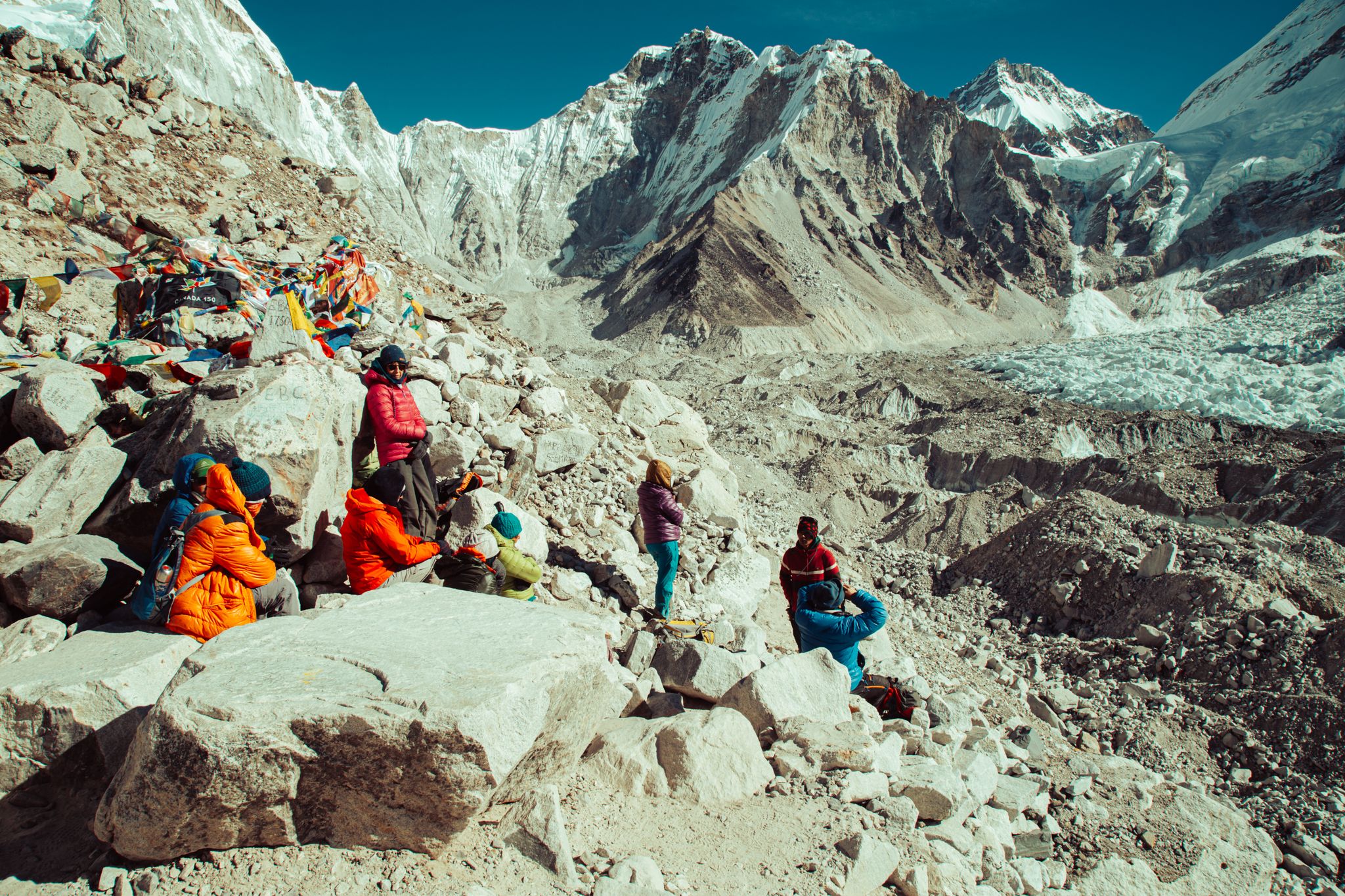
EBC is the classic for reasons that survive the crowds. The trail itself is a pageant - Tengboche monastery under Ama Dablam, the memorial chortens above Dughla, the ice towers of the Khumbu - and it ends standing at the foot of the mountain itself, beside the icefall that every Everest story you have ever read begins with. Kala Patthar (5,545 m) at dawn puts the summit pyramid close enough to read the wind plume.
The infrastructure is unmatched: lodges with menus and bakeries most of the way up, the social energy of a trail where the whole world walks together, and the simplest logistics in high-altitude Nepal. For a first Himalayan trek where confidence matters, that scaffolding counts. The full route is in our EBC itinerary, and the honest worth-it verdict weighs the crowds question directly.
Difficulty: effectively a tie
Both treks share the Lukla start, the same acclimatisation profile, and viewpoints within 200 m of altitude of each other. Gokyo's stages are slightly shorter on average; EBC's trail is busier but better marked. The decisive factors are the same on either: acclimatisation discipline (the training plan covers preparation), insurance that covers 5,500 m and helicopter evacuation, and buffer days for the Lukla flight. Teahouse food logic is identical too - dal bhat power rules both valleys.
Or do both: the Cho La
The strong-legs answer is the combination: up the Gokyo valley, over the Cho La (5,420 m) - a genuine glacier pass with a pre-dawn start and, in cold months, microspikes - then down to join the EBC trail at Lobuche for Base Camp and Kala Patthar. Sixteen to eighteen days, both signature sights, one trek. Go clockwise (Gokyo first) for better acclimatisation logic. Add the Renjo La and Kongma La and you have the full Three Passes trek, the region's grand tour.
Permits and logistics: identical
Whichever route you pick, the paperwork is the same: the Sagarmatha National Park permit and the Khumbu Pasang Lhamu Rural Municipality fee, both payable on the way in at Monjo or Lukla - no TIMS card needed in this region; verify current fees. The Lukla flight is also a shared reality: in peak season many departures leave from Ramechhap (a 4-5 hour pre-dawn drive from Kathmandu) rather than Kathmandu itself, and weather holds of a day or two are routine in any month. Two buffer days between the trek's end and your international flight is the standard insurance, and helicopter operators fill the gap when schedules collapse - at a price worth insuring against rather than paying.
The verdict
- Choose Gokyo if you value quiet trails, the lakes, and the single best panorama in the Khumbu - and don't need the Base Camp name.
- Choose EBC if the point is Everest itself, the story, and maximum infrastructure for a first big trek.
- Choose the Cho La combination if you have 16+ days and the fitness - it makes the choice unnecessary.
Whichever way you turn above Namche, book the October-November or March-April windows, pack for cold nights (packing list), and leave the itinerary a buffer day. The mountains reward whichever valley you give them.