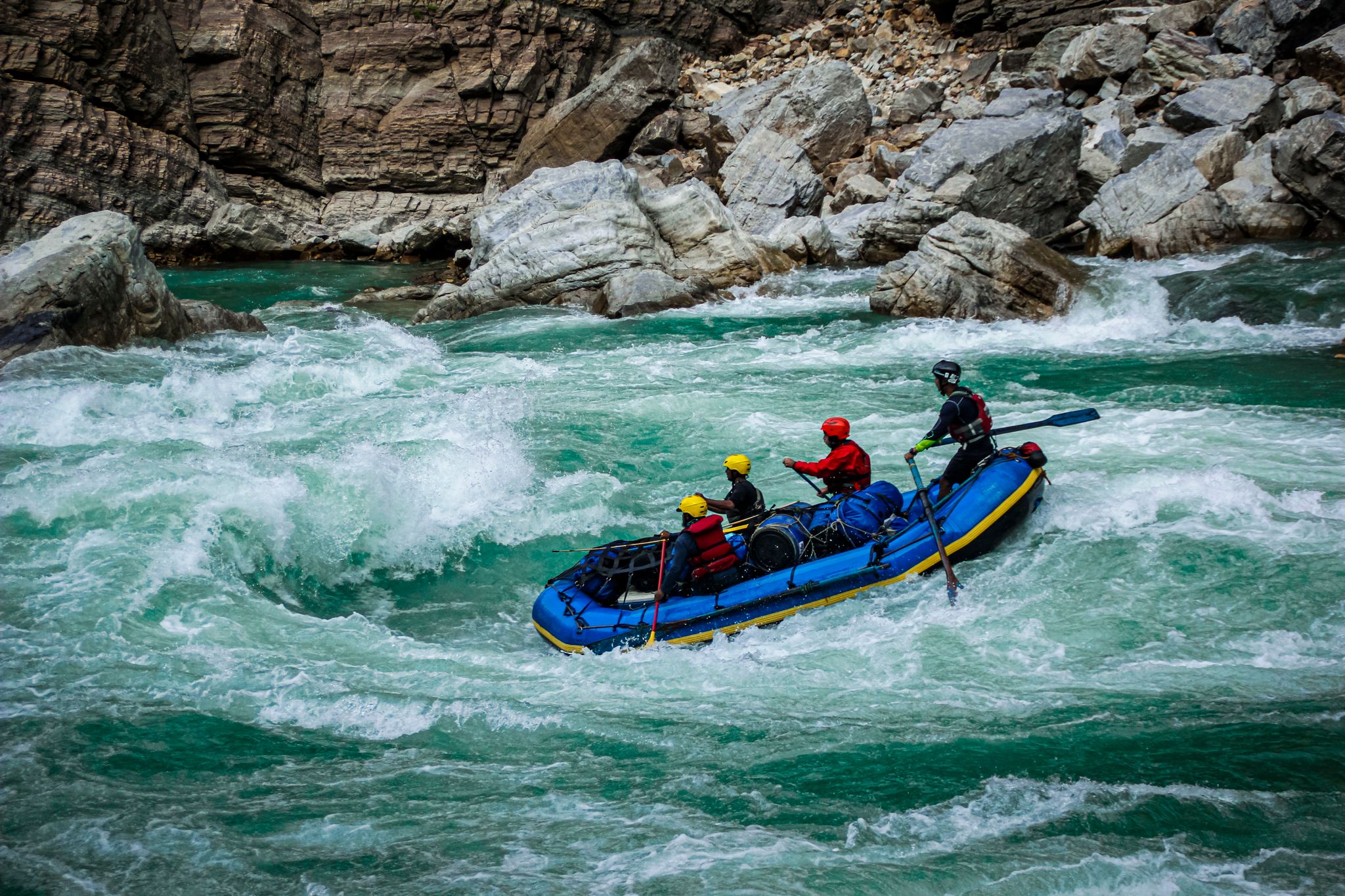
Nepal's mountains get the fame, but its rivers are world-class in their own right - snowmelt torrents that carve from the Himalaya to the Ganges plain through gorges most travelers only see from a bus window. White water rafting in Nepal ranges from splashy half-days to ten-day wilderness expeditions rated among the best river journeys on earth. Here's how the rivers compare, and which one is yours.
Trisuli: the everyone river
The Trisuli runs beside the Kathmandu-Pokhara highway, which makes it Nepal's most rafted river by far - half-day and full-day trips with grade 2-3 rapids that thrill first-timers without terrifying them, easy pickup logistics from either city, and beach lunch stops. It's the natural add-on: break the highway journey with a rafting day and arrive in Pokhara salt-crusted and grinning. Families with teens, first-timers, and anyone short on time start here.
Rafting the Trisuli - Nepal's classic run (Santosh Kunwar)Bhote Koshi: the adrenaline shot
Near the Tibet border northeast of Kathmandu, the Bhote Koshi crams Nepal's steepest commercial whitewater into a short, relentless run - grade 4+ in season, rapids stacked back-to-back, often paired with bungee jumping at the gorge for a full adrenaline weekend. It's the connoisseur's day trip: previous rafting experience strongly recommended, rewards proportional.
Kali Gandaki: the scenic expedition
West of Pokhara, the Kali Gandaki - the river that carved the world's deepest gorge upstream - offers the classic 3-day expedition: grade 3-4 rapids, nights camped on white-sand beaches, temples and cremation ghats along a holy river, and no roads in earshot. The gateway multi-day trip.
 Scouting the line - multi-day trips run wilderness gorges far from any road
Sun Koshi: the legend
The Sun Koshi - "river of gold" - is the big one: 8-10 days and ~270 km from the hills near Kathmandu to the Ganges plain, consistently listed among the world's top ten river journeys. Warm water, building rapids that peak in muscular grade 4-5 trains, beach camps under the stars, and the rare experience of crossing Nepal's entire vertical geography by raft. For anyone with expedition appetite, it rivals a trek for trip-of-a-lifetime status.
The rivers at a glance
| River | Grade | Length | Best for |
|---|---|---|---|
| Trisuli | 2-3 | Half-2 days | First-timers, highway add-on |
| Bhote Koshi | 4+ | 1-2 days | Adrenaline, experienced |
| Kali Gandaki | 3-4 | 3 days | First expedition |
| Sun Koshi | 3-5 | 8-10 days | The classic journey |
| Seti | 2 | 1-2 days | Gentle, warm, family |
What a rafting day actually feels like
The rhythm, for the uninitiated: a safety briefing that sounds alarming and is actually reassuring (falling out is planned-for, not catastrophic), a practice stretch of flat water to learn the paddle calls - forward, back, get down - and then the guide reading each rapid aloud like a menu before you drop in. The rapids come as bursts of chaos punctuating long calm stretches where the gorge does the entertaining: waterfalls threading down cliffs, suspension bridges overhead, kingfishers, sand beaches. Expect to be soaked from the first rapid and grinning from the second. On multi-day trips the rhythm expands - paddle mornings, beach camps by mid-afternoon, driftwood fires, and a night sky the mountains usually keep to themselves.
Rafting vs kayaking vs canyoning
Rafting is the entry point, but the rivers offer more: kayak clinics (multi-day beginner courses, mostly on the Seti and around Pokhara) turn passengers into paddlers; canyoning - abseiling down waterfalls in wetsuits - runs near the Bhote Koshi and around Pokhara for those who want the water vertical; and safety kayakers on any raft trip are usually happy to talk shop about the progression. If the Sun Koshi lights something up in you, the kayak clinic is the gateway drug.
Season, cost, and choosing an operator
October-November and March-May are prime - warm, reliable, settled. The monsoon turns everything up: huge water for experts on chosen sections, off-limits for beginners (what monsoon is good for). Costs run roughly USD 40-80 for Trisuli day trips to per-day expedition rates for the Sun Koshi - verify current prices, and treat suspiciously cheap quotes as the safety warning they are.
The operator matters more than the river: look for certified guides, quality equipment, safety kayakers on grade 4+, honest river grading, and real briefings. Kathmandu's Thamel and Pokhara's Lakeside are full of agencies; the good ones answer safety questions happily. Confirm your travel insurance covers rafting - many base policies don't.
Practicalities
- You'll get thrown in (figuratively): swimming a rapid in a PFD is a normal part of the sport - the briefing covers it; listen.
- Pack quick-dry layers, straps for glasses, and a dry change; operators provide helmets, PFDs, and dry bags (packing list).
- Combine it: Trisuli en route to Pokhara, Bhote Koshi with the bungee, Kali Gandaki after a Poon Hill trek - rivers slot neatly into every itinerary.
- Cold is real outside autumn - wetsuits provided in cooler months; the water was snow last week.
The Himalaya built these rivers steep and generous, and a day in the waves is the perfect counterweight to the trails. Make room for one when you map out the trip. And if the Sun Koshi calls, answer.