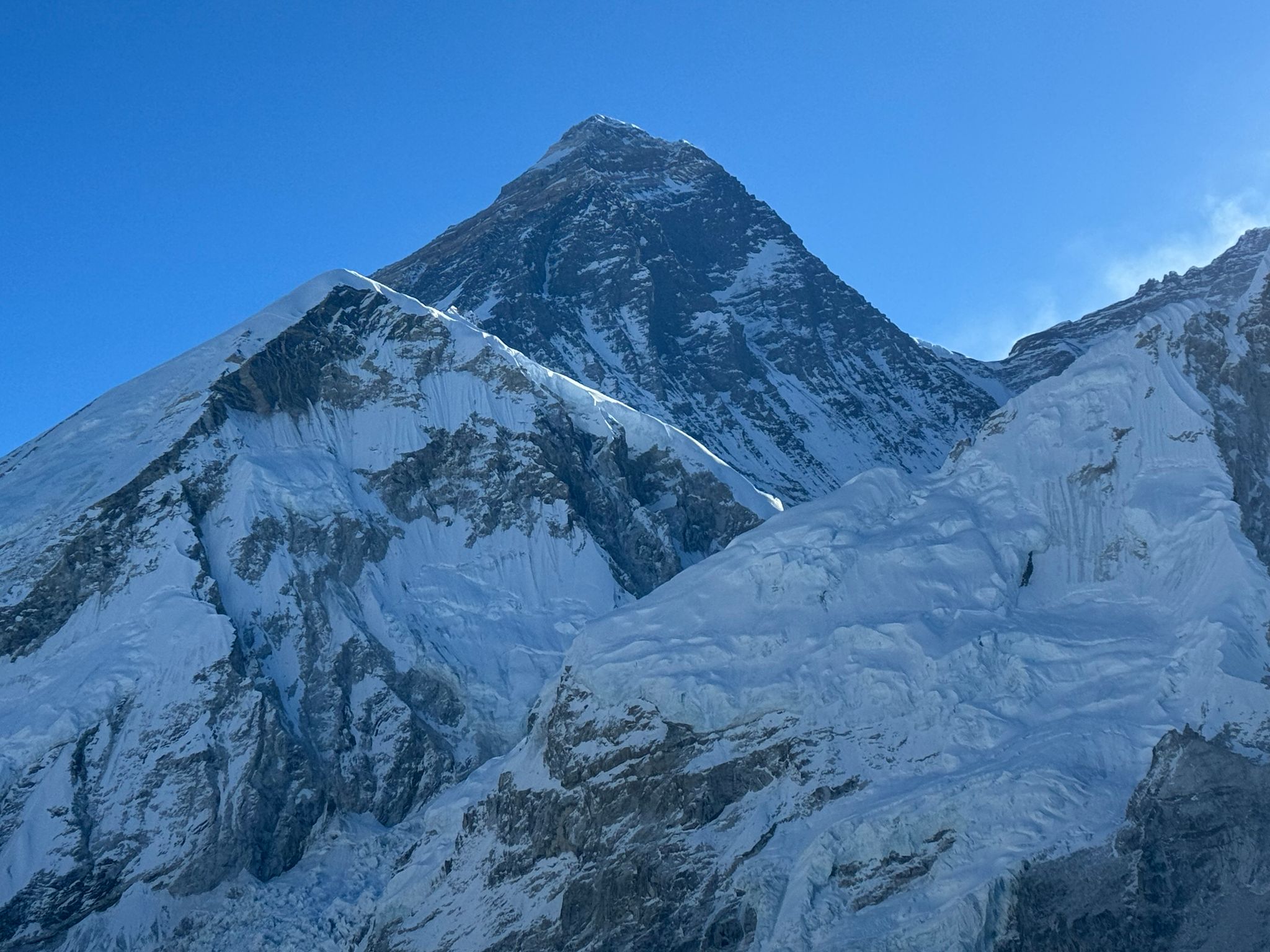

The Everest mountain flight is Nepal's most famous shortcut: departure from Kathmandu around sunrise, an hour tracing the Himalayan wall east to Everest and back, and a landing before breakfast. It is also one of the country's pricier hours, so the question every traveler asks is fair. Worth it or not? Having weighed it against the alternatives, here is the honest picture.
What the flight actually is
Buddha Air and Yeti Airlines run these flights every clear morning from Kathmandu's domestic terminal, mostly on ATR turboprops. Every seat is a window seat, the cabin holds far fewer passengers than the plane could carry, and a route card helps you name the peaks as they pass: Langtang and Ganesh Himal first, then Gauri Shankar, Melungtse across the Tibetan border, Cho Oyu, and finally the black pyramid of Everest beside Lhotse and Nuptse. The aircraft turns before the massif and repeats the show for the other side of the cabin on the way home.
Two touches lift it above a normal flight. Cabin crew walk the aisle pointing out summits by name, and passengers are invited forward in pairs for a moment in the cockpit doorway, where the range fills the windscreen. That view, straight down the spine of the Himalaya, is the one people remember.
The full uncut mountain flight experience from Kathmandu (One Living Life)How close do you get? The aircraft holds a respectful distance from the peaks, cruising around 25,000 ft, which puts the summit of Everest slightly above you and perhaps twenty-odd kilometres away at the nearest point. That sounds far until you are there. At that range the mountain still dominates the window, and the sensation of flying level with an 8,000-metre summit line is what no photograph from the ground reproduces.
What it costs and how to book
Foreigners typically pay in the low USD 200s; Nepalis and Indian citizens pay much less. Verify current fares before booking, as they move with fuel prices and season. Booking direct with the airline or through any Thamel agent both work; agents sometimes discount slightly. Flights leave in a morning wave from about 6:30 am, when the air is calmest and clearest, and weather cancellations roll you to the next day or refund you. Build a spare morning into your Kathmandu itinerary rather than booking it for your final day.
The honest downsides
A review that only cheers is not a review, so:
- Haze is the enemy. Even when flights operate, spring and pre-monsoon mornings can wrap the range in a milky veil. October to February gives the sharpest air. Our best-season guide explains the pattern.
- You are behind glass. Propeller blur and window reflections frustrate photographers; shoot with the lens close to the pane and expectations managed.
- It is brief. Roughly 20 minutes of the hour is prime mountain wall. The experience is a tasting, not a meal.
- Turbulence happens. Mornings are usually smooth, but nervous flyers should know these are small aircraft near big terrain, flown by crews who do this daily.
 Domestic aviation, Himalayan backdrop - Nepal's turboprops fly beneath scenery like nowhere else
Flight vs trek vs helicopter
| Option | Time | Rough cost | What you get |
|---|---|---|---|
| Mountain flight | 1 hour | Low USD 200s | Full range panorama incl. Everest, zero effort |
| EBC trek | 12-14 days | USD 1,200+ | The full immersion; Everest from below, not above |
| Helicopter EBC tour | Half day | USD 1,000+ pp | Landing at Kala Patthar side, champagne-tour style |
| Pokhara ultralight | 15-90 min | Varies | Annapurnas up close, open cockpit |
The flight is not a substitute for the trek and does not pretend to be. It competes with the helicopter tour, at a fifth of the price, and wins on simplicity: no altitude exposure, no weather risk beyond a rescheduled morning, no fitness requirement. Grandparents take this flight. So do trekkers who just walked to Base Camp and want the view from the other axis.
Who should book it
- Short-trip travelers whose one-week itinerary has no room for a trek but who refuse to leave without seeing Everest.
- Families and older travelers for whom altitude rules out the walking options.
- Trekkers headed elsewhere - if your boots are pointed at Annapurna or Langtang, this is the morning that adds Everest to the trip.
- Anyone weather-burned who spent a cloudy week hoping and wants a guaranteed-or-rebooked shot at the range.
If you have the time, fitness, and budget for the full Base Camp trek, the trek remains the deeper experience and this flight becomes optional dessert.
Making the most of your hour
Book the earliest departure you can get; the first wave flies in the calmest, clearest air. Keep the camera strap on and spend some of the flight just looking - the cockpit moment in particular is better witnessed than filmed. Sit loose about your seat assignment, since the turn shows both sides everything. And bring your passport for the domestic terminal, where airport procedures are informal but ID is still checked.
One hour after take-off you are back on the tarmac at Tribhuvan, mildly stunned, holding a phone full of ridge lines. Whether that is worth a low-three-figures fare depends on your budget and your itinerary. What it delivers is not in question: the highest mountains on Earth, at eye level, before your morning coffee.